Understanding the Differences and Choosing the Right Technology for Your Application
Whether it is a handheld test instrument, marine navigation system or industrial HMI, if users cannot clearly read the display, the product will not perform as intended.
Lighting conditions can significantly affect display performance. Choosing the right TFT technology can improve visibility, reduce power consumption and enhance the user experience.
Transmissive TFTs are widely used and typically offer excellent brightness, colour reproduction and indoor image quality. Transflective TFTs offer an advantage in bright environments by using ambient light to support readability.
How They Work
Transmissive TFT
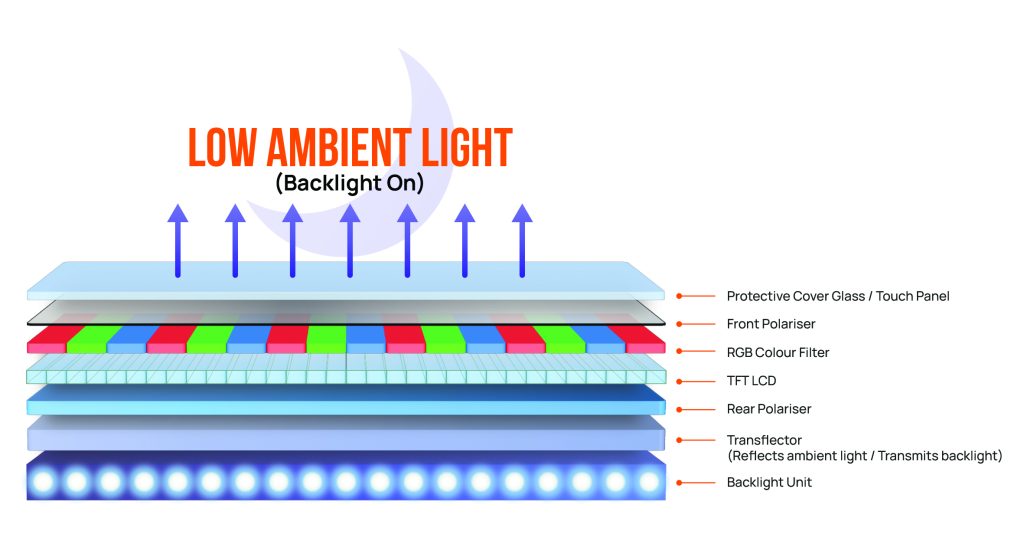
A transmissive TFT relies on a backlight, usually an LED backlight unit, to illuminate the image. Light passes through optical films, polarisers, the liquid-crystal layer and colour filters before reaching the viewer.
Thin-film transistors control the voltage applied across the liquid-crystal material, regulating how much light passes through.
Because all illumination comes from the backlight, transmissive TFTs usually deliver bright colours, high contrast and consistent image quality indoors. In strong ambient light or direct sunlight, however, reflections from any of the internal structure, can reduce visible contrast. Unless the display is enhanced for outdoor use, the image may become difficult to read.
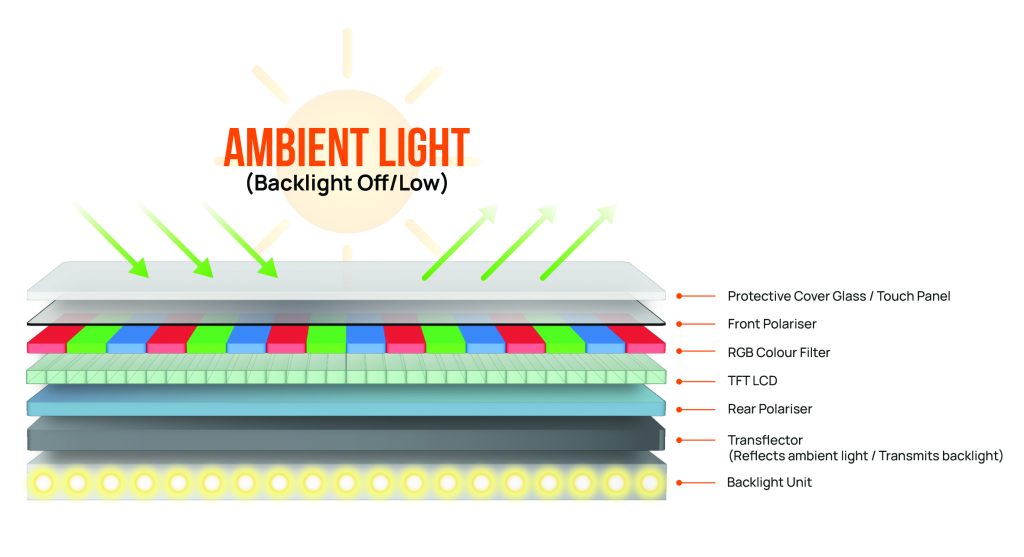
A transflective TFT incorporates an optical structure that both transmits light from the backlight and reflects incoming ambient light. Depending on the design, this may use a partially reflective layer.
In low light, the display operates mainly in transmissive mode using its backlight. In bright conditions, incoming light is reflected back towards the viewer.
As ambient light increases, the reflected component contributes more strongly, helping the display maintain usable contrast and readability. Rather than relying solely on increased backlight brightness to compete with sunlight, it uses the available ambient light.
This dual-mode operation can provide good visibility and may reduce power consumption when the backlight is dimmed or switched off.
Technology Comparison
| Feature | Transmissive TFT | Transflective TFT |
| Indoor image quality | Typically excellent | Good to very good |
| Direct sunlight readability | Limited in standard designs | Typically good to excellent |
| Colour reproduction | Typically excellent | Usually lower in reflective mode |
| Contrast in bright light | Usually reduced unless enhanced | Better maintained |
| Power consumption | Often higher | Lower |
| Product availability | Extensive | More limited |
Performance also depends on the cover lens, touchscreen, bonding method and surface treatments.
Advantages of Transflective TFT Displays
Transflective technology is designed for environments with high ambient light.
Key benefits include:
- Improved readability in bright light and direct sunlight
- Better-maintained contrast outdoors
- Potentially lower backlight power in bright conditions
- Improved battery life where the backlight can be reduced
- Good performance across changing indoor and outdoor environments
Considerations include:
- Higher panel cost
- More limited availability
- Typically, lower transmissive brightness
- Reduced colour saturation, particularly in reflective mode
- Fewer available sizes, resolutions and interfaces
The power benefit depends on backlight control. A transflective TFT will not automatically consume less power unless the backlight is reduced when sufficient ambient light is available.
Advantages of Transmissive TFT Displays
Transmissive TFTs remain the most common choice because of their optical performance, availability and competitive cost.
Key benefits include:
- Excellent brightness and colour reproduction
- High contrast and image clarity indoors
- Wide choice of sizes, resolutions and interfaces
- Lower panel cost in many applications
- Broad availability from multiple manufacturers
Considerations include:
- Reduced readability in direct sunlight unless enhanced
- Higher backlight power where increased brightness is required
- Greater heat generation at high backlight levels
- Possible need for optical bonding or anti-reflective treatments
A high-brightness transmissive TFT can still provide very good outdoor performance, particularly when combined with optical bonding and low-reflection surface treatments.
Which Display Technology Is Right for Your Application?
There is no single display technology that suits every application. The ideal solution depends on the operating environment, lighting conditions, power budget, colour requirements, touchscreen integration, cost and product availability.
For many indoor applications, a standard transmissive TFT provides the best balance of image quality, availability and cost.
Where equipment is regularly used outdoors or exposed to strong ambient light, a transflective TFT can provide significant readability benefits while potentially reducing backlight power requirements.
However, transflective technology is not the only route to outdoor readability. High-brightness TFTs, optical bonding, anti-reflective coatings and anti-glare treatments may provide a better balance of performance and cost in some applications.
Cover lenses, touchscreens and air gaps can introduce reflections that reduce contrast. Optical bonding can reduce these reflections while improving mechanical strength and moisture resistance.
Testing sample displays under representative lighting conditions is often the best way to confirm the most suitable solution.
Speak to the Display Specialists
Selecting the right technology means ensuring the complete display assembly performs reliably in the real world.
Examples of TFT Transflective Displays here.
With over 45 years of experience in industrial display solutions, Relec works closely with engineers and design teams to identify the most suitable technology for each application.
Whether you require a standard transmissive TFT, a transflective display or a customised solution with optical enhancements and PCAP touch integration, our team can guide you through the options.
If you are starting a new design or improving an existing product, contact the Relec engineering team. We will help you balance readability, image quality, power consumption, reliability and cost.
Keep up to date with our latest news over at LinkedIn and let’s stay connected! 🔗